Original generated wording
At the June 10, 2024 follow-up, the patient reported approximately 50% relief following the May 6, 2024 epidural steroid injection, with pain now 4/10. [6] Modified duty was continued, with re-evaluation in 6 weeks. [6]
Actual application output · fictional records
This is a retained seven-page Alex Testcase run from 2026-10-20. Compare the application-generated chronology with its source, inspect the disclosed edit, and open the Word exports.
Historical example, not a new run on today’s production model. This single case establishes no accuracy, completeness or time-saving rate. No medical opinions or report approval are supplied.
Four steps through one fictional example. You can move freely; visiting a step does not mark a task complete. Your place within this guide is not saved.
Open the fictional packet. Use PDF viewer page numbers; printed footers restart within the packet.
Use PDF viewer page numbers. Printed footers restart within the packet. All people and records are fictional.
Shorten wording while retaining reported treatment response, pain score, work status and follow-up. Source citations were unchanged.
Loading page image…
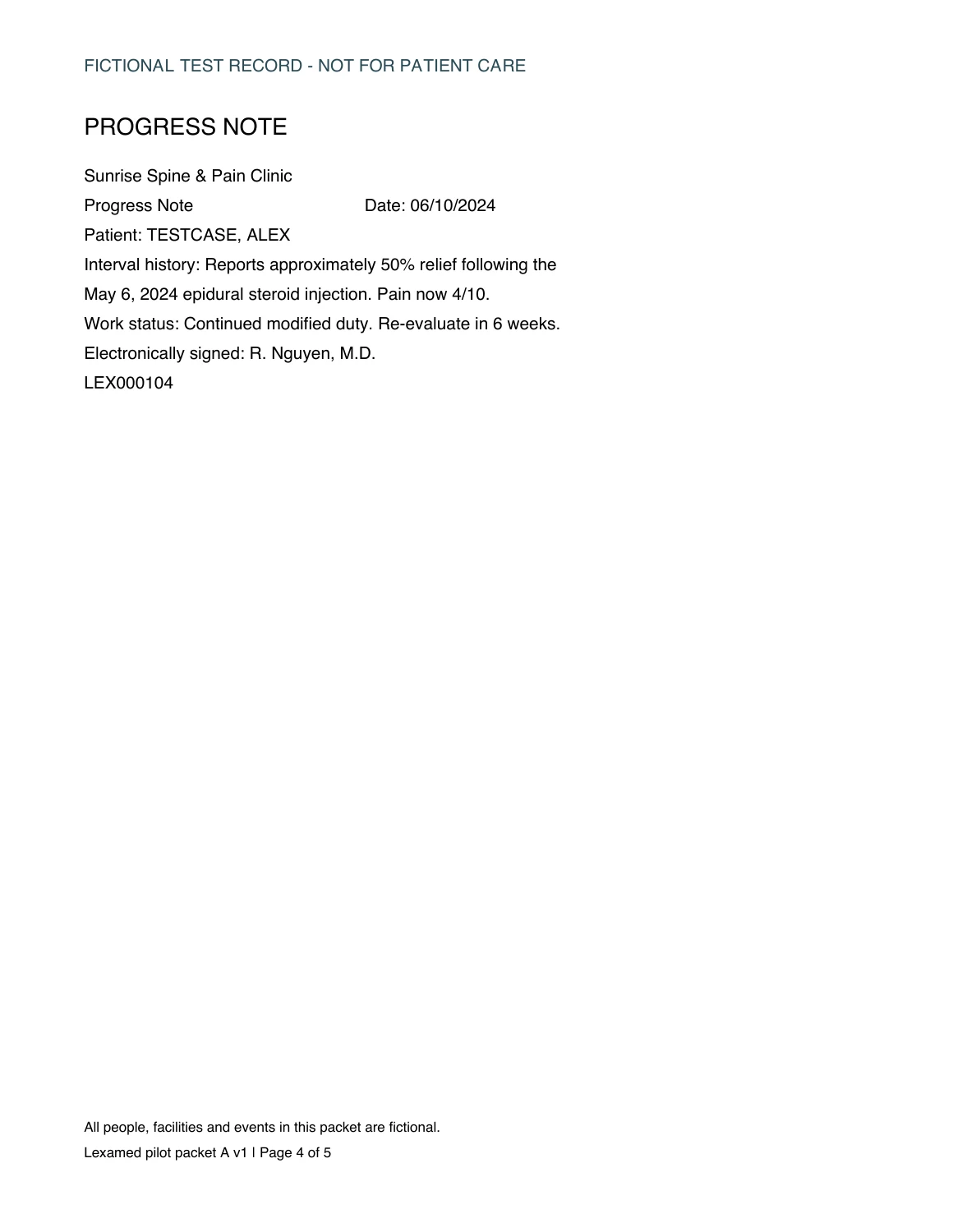
At the June 10, 2024 follow-up, the patient reported approximately 50% relief following the May 6, 2024 epidural steroid injection, with pain now 4/10. [6] Modified duty was continued, with re-evaluation in 6 weeks. [6]
Reported approximately 50% relief after the May 6, 2024 epidural steroid injection; pain 4/10. Continued modified duty with re-evaluation in 6 weeks. [6]
Citations were preserved. This documented wording edit is not independent clinical verification; compare both statements with the source.
Preview the exact Word exports. The report is a separate historical draft with evaluator placeholders; it was not regenerated after the chronology edit.
When browser storage is available, this tab remembers only the public document, preview page and image/text mode, independently of optional measurement. Search phrases and selected citations are not saved.
Word (.docx) is editable. PDF is the fixed preview of this selected export. Page counts refer to the PDF; Word pagination can vary by application. After downloading, open the file and confirm its contents.
These section links refer to document preview pages. Evaluator placeholders remain uncompleted; section labels do not certify a report.
Focus this navigation box and use ← / → for pages, Home for the first page, or End for the last.
Original chronology wording · page 1 of 2
In Text alternative, select a linked packet citation to inspect its source beside the document (below it on mobile). Source PDF viewer pages differ from document preview pages. Other references remain plain text.
Loading page image…
Switch to Text alternative, try Fit width or zoom, or open the complete PDF. If the image failed to load, the text alternative remains available.
Prepare a support emailOnly the selected issue category is placed in the email subject. Nothing is sent automatically. Do not include patient information, document text, passwords or private links. Optional measurement records only that help or its category selector was used.
Use this public fictional example. These are self-reported usability outcomes, not clinical accuracy, approval or an independently observed test. No account is needed.
Each outcome category is counted at most once per tab. No names, search phrases, source pages or document text are sent. Your global privacy preference and DNT/GPC still apply. Separate totals do not identify people or establish a completion rate.
For an observed session, have a facilitator watch the actions and record assistance separately. No observed sessions or participant results are claimed here.
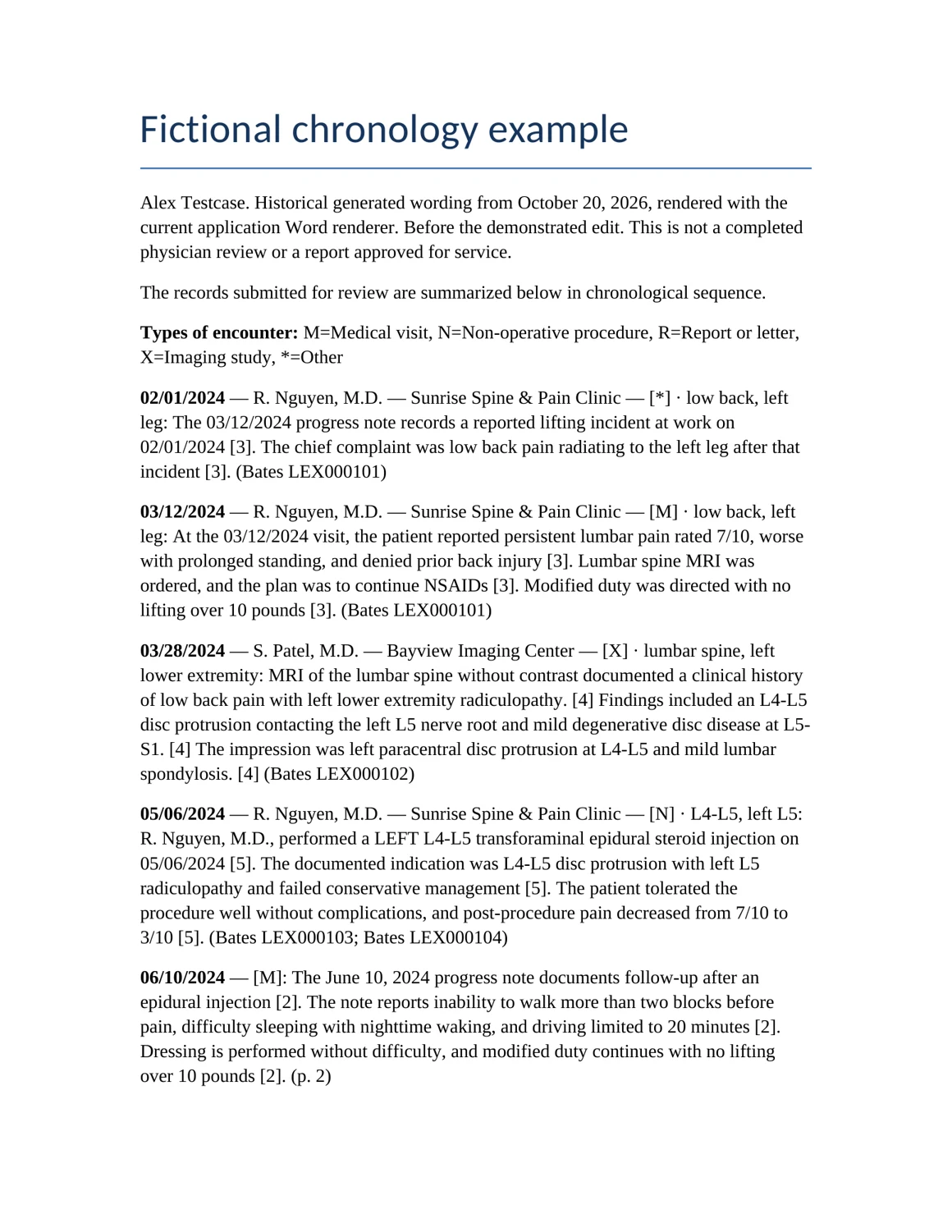
The 03/12/2024 progress note records a reported lifting incident at work on 02/01/2024 [3]. The chief complaint was low back pain radiating to the left leg after that incident [3].
At the 03/12/2024 visit, the patient reported persistent lumbar pain rated 7/10, worse with prolonged standing, and denied prior back injury [3]. Lumbar spine MRI was ordered, and the plan was to continue NSAIDs [3]. Modified duty was directed with no lifting over 10 pounds [3].
MRI of the lumbar spine without contrast documented a clinical history of low back pain with left lower extremity radiculopathy. [4] Findings included an L4-L5 disc protrusion contacting the left L5 nerve root and mild degenerative disc disease at L5-S1. [4] The impression was left paracentral disc protrusion at L4-L5 and mild lumbar spondylosis. [4]
R. Nguyen, M.D., performed a LEFT L4-L5 transforaminal epidural steroid injection on 05/06/2024 [5]. The documented indication was L4-L5 disc protrusion with left L5 radiculopathy and failed conservative management [5]. The patient tolerated the procedure well without complications, and post-procedure pain decreased from 7/10 to 3/10 [5].
The June 10, 2024 progress note documents follow-up after an epidural injection [2]. The note reports inability to walk more than two blocks before pain, difficulty sleeping with nighttime waking, and driving limited to 20 minutes [2]. Dressing is performed without difficulty, and modified duty continues with no lifting over 10 pounds [2].
At the June 10, 2024 follow-up, the patient reported approximately 50% relief following the May 6, 2024 epidural steroid injection, with pain now 4/10. [6] Modified duty was continued, with re-evaluation in 6 weeks. [6]
Correspondence from Law Offices of North Shore Defense asks whether medical findings are consistent with a February 1, 2024 lifting incident [1]. It also asks whether a referenced March 28, 2024 MRI supports left L5 contact and whether the records document prior lumbar injury; these are questions posed by the correspondence, not independent clinical findings [1].
The chronology exports use the retained wording and the current product renderer. The separate report retains evaluator placeholders and a documented renderer-only timing-label correction; it requires physician review.
Historical processing source: 127fef761566c5508b245d0bd469aaa4fd017cbf. Chronology rendering source: b33df81aaef92d1316c4559bb180ca866e01ff63.
Exact model name was not retained in this snapshot. Configuration fingerprint: chronology-e5d7fd65093557ac. We make no provider or model comparison claim.
The source packet and every downloadable output have SHA-256 hashes in the manifest. Regenerating with a configured model can produce different wording.
Use the same seven-page Alex Testcase packet in your own workspace. The guide can preload the PDF and case details; the archived wording and edit shown here are not copied into your case. A new run can produce different wording.
Continue to the guide, signing in if needed. Review the prefilled details before creating a case, then review the estimate and explicitly confirm processing. Following this link does not create or process a case.
Continue to fictional testFictional records only. No card or subscription. Already started a test? Resume the existing case from the guide.